Appraised on productive value, not market value
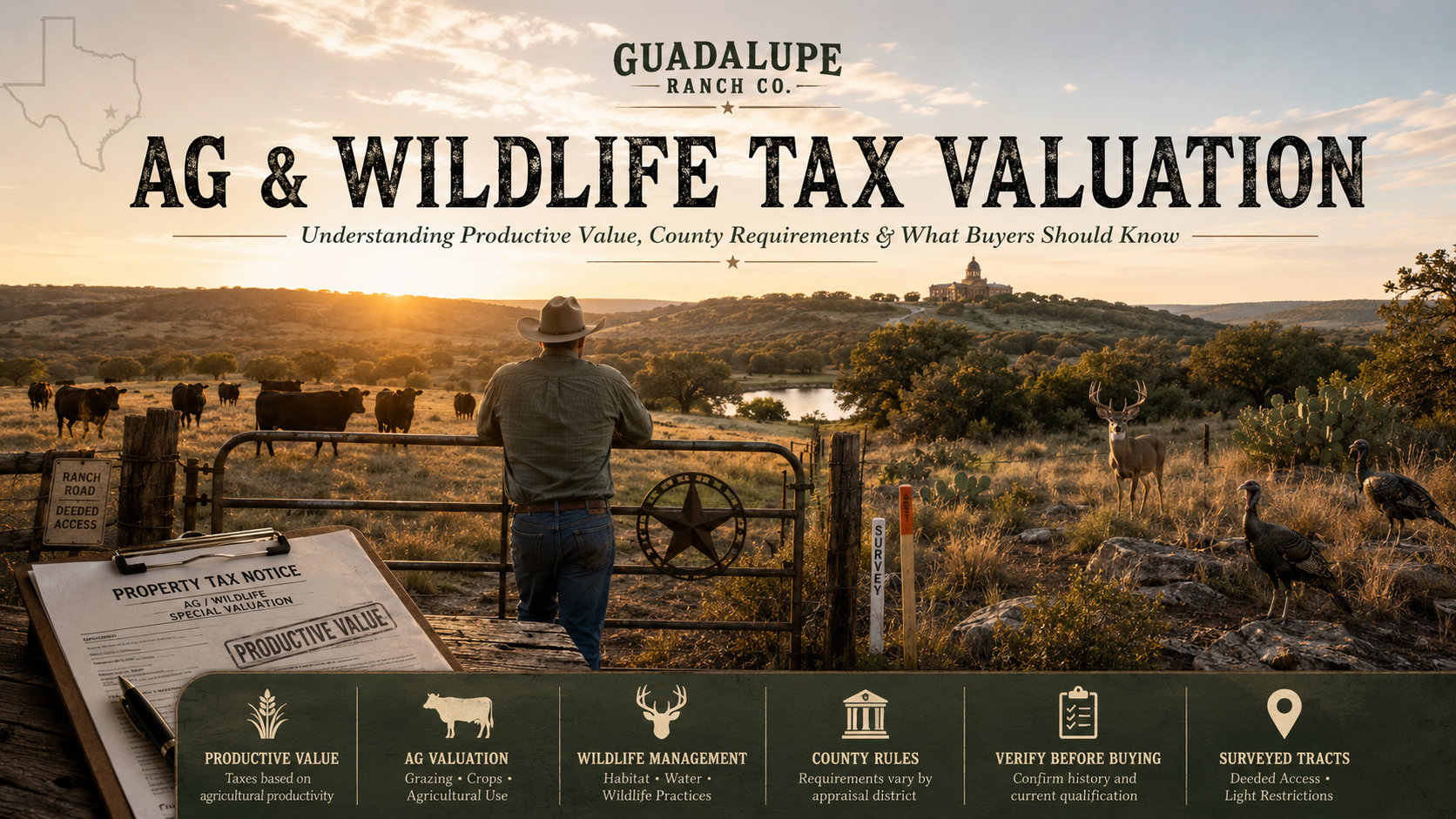
Texas allows qualifying rural land to be appraised on its productive agricultural value rather than its full market value. Because the property tax you owe is based on the appraised value, land that qualifies for this special valuation is generally taxed far more in line with what it produces than with what it might sell for. For working ranch and recreational tracts, that distinction can make a meaningful difference in the annual tax bill.
It's important to be precise about the language, because buyers hear it loosely. This is a special method of valuation, not a true exemption — the land isn't taken off the tax roll, it's appraised on a different basis. That's why the productive-value treatment is something a property qualifies for and maintains, rather than a one-time status you receive and forget.
Agricultural-use special valuation (the so-called "ag exemption")
The path most people have heard of is agricultural-use special valuation, commonly — and inaccurately — called the "ag exemption." It applies to land that is being used to a qualifying degree for agriculture, which can include uses such as grazing livestock, raising crops, or other recognized agricultural activity. When land qualifies, it is appraised on its agricultural productivity rather than its market value.
Because it depends on actual use, this valuation typically expects the land to be genuinely devoted to agriculture, and it usually looks at how the land has been used over time rather than just how it's used today. The specifics of what counts, and how much activity is enough, are not set in stone statewide — they're administered locally, which we'll come back to below.
Wildlife-management valuation
The second path is wildlife-management valuation. In broad terms, it lets a landowner keep a special valuation by managing the land for wildlife instead of running traditional agriculture. Land generally has to already qualify under the agricultural valuation before it can convert to wildlife management, after which the owner maintains the valuation by carrying out qualifying wildlife practices on the property.
Those practices commonly fall into recognized categories such as habitat work, supplemental food or water, predator control, providing shelter, and population or census activity — the goal being to actively benefit a target wildlife population. For many recreational and hunting buyers this is an attractive route, because it lets them keep favorable tax treatment while managing the land the way they actually want to use it. The exact practices required, and how they must be documented, are set locally.
Requirements are set and administered at the county level
Here is the part that surprises buyers most: the detailed requirements for these valuations are set and administered at the county level. The county appraisal district decides what qualifies in that county, including expectations around the history of use, the minimum level of agricultural or wildlife activity, and the kind of records you need to keep. Two neighboring counties can apply the rules differently.
That local control means you can't safely rely on a number you heard for one county, or on what a tract carried under a previous owner, as if it applied everywhere. A change in ownership or in how the land is used can also affect whether a valuation continues. Treat any general statement — including the ones in this guide — as background, and treat the county appraisal district as the authority on a specific tract.
Confirm before you rely on any tax treatment
Our strong, consistent advice is the same one we give on every tract: before you count on any property-tax treatment, confirm the current rules, the tract's history of use, and exactly what it would take to establish or keep the valuation with the local county appraisal district. That's the office that grants and reviews the valuation, and it's the only place that can tell you authoritatively where a given tract stands.
Every tract we sell is surveyed with deeded access on graded ranch roads, and we're glad to share what we know about how a property has been used and valued. But the appraisal district is the authority on its valuation, not us — so when the tax treatment matters to your numbers, verify it there in writing before you rely on it. If you're weighing a tract and want to understand the questions to ask, ask us and we'll point you in the right direction.