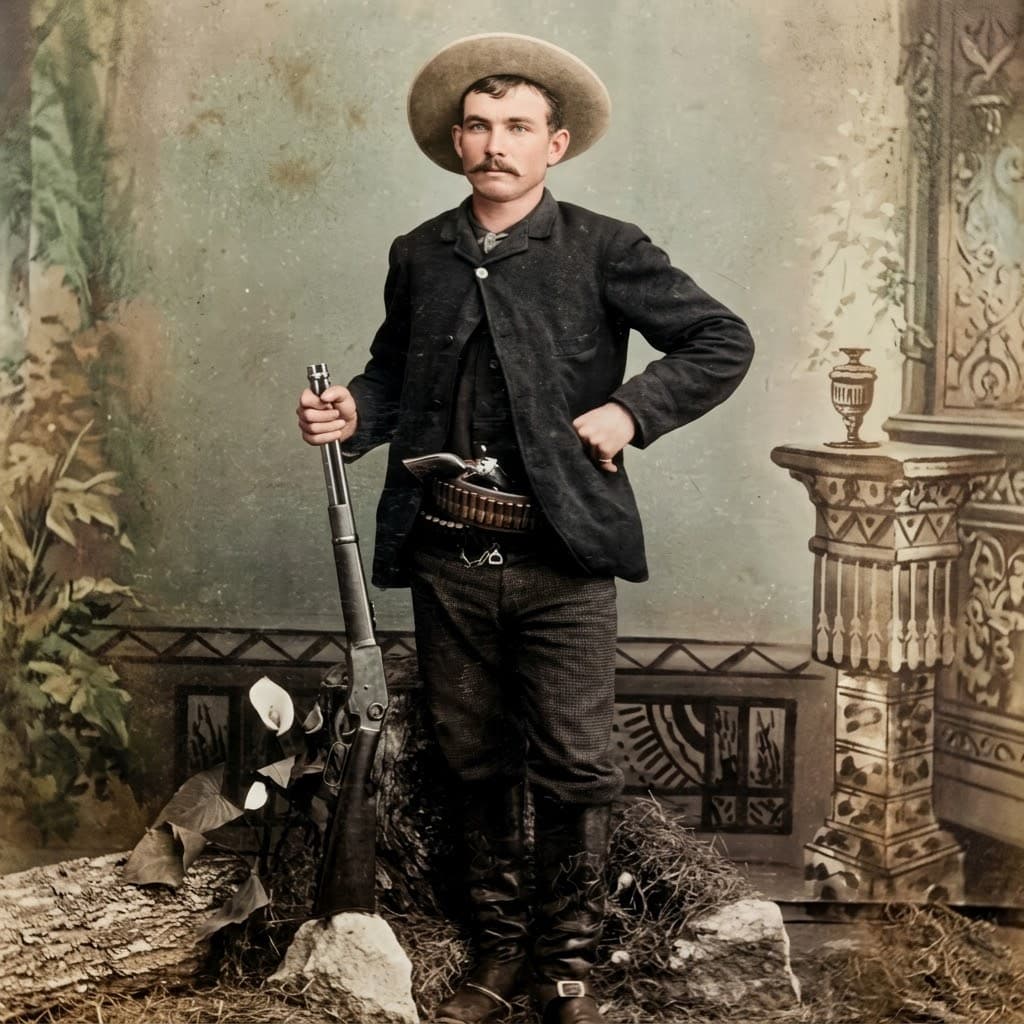
His youngest boy found him. Henry Braeutigam was 10 years old on September 3, 1884, when he walked into his father's saloon in the old officers' quarters at Fort Martin Scott and found him on the floor with his rifle still on the wall. The family had buried another son, Max, 18, a month before. That is the kind of year it was.
Kaltenlengsfeld to the Pedernales
Johann Wolfgang Braeutigam was born in March 1829 at Kaltenlengsfeld, a village in Thuringia, the third child of Johann Valentin and Maria Elisabeth Braeutigam. The family history gives the date as March 16; the stone in Fredericksburg says March 29. His family joined the German emigration to Texas in 1845, sailed about 3 months, and landed at Indianola on December 18 of that year, according to the land certificate he signed later. They waited out the winter on the coast, walked and rode to New Braunfels, and in 1846 were among the first families in Fredericksburg.
He was 18 when he signed the petition of December 12, 1847, asking the Legislature to make a county out of the settlement, and Gillespie County was created the following February. He drew town lot 564 on what is now Peach Street. On September 1, 1850, he married Christine Kensing, who had lost her mother and a sister to cholera at Indianola and her father at Victoria before she turned 15. He became a citizen on May 12, 1851. In 1853 he sold the 320-acre headright the state had given him, up in the Comanche country near the old San Saba fort, for $20, which tells you what land was worth where nobody could hold it.
He farmed 200 acres at Grape Creek, the settlement that later became Luckenbach, through the 1850s and the war. Gillespie County voted 400 to 17 against secession, and Braeutigam did what most of his neighbors did: he kept his head down, voted in the home guard election of 1862, and served 8 days in the state troops in 1864 at $2 a day.
The Garten
In March 1870 he bought 640 acres on Barons Creek, 2 miles out the San Antonio road, that happened to include the abandoned post the Army had named for Major Martin Scott. The buildings had been stripped by scavengers; the stone guardhouse was sound. The Braeutigams built their house onto it and turned the commanding officer's quarters into a saloon. He added a store, a grape arbor, and between the 2 buildings what is said to have been the first dance hall in the county. The old parade ground became a race track. In 1881 the first Gillespie County Fair was held on his land, the start of what is billed as the oldest continuous county fair in Texas; the first 4 fairs were at Braeutigam's Garten.
By the 1880 census he was running a couple of hundred sheep and some cattle, growing corn, wheat and a little cotton, and selling beer to the county on weekends. He was 55 and doing well.
September 3, 1884
Strangers rode up to the Garten that afternoon, 3 by the family's count and 4 by the state's, and asked for drinks. One of them drew a revolver and demanded the cash box. Braeutigam refused and reached for his rifle, and the man shot him. The box held almost nothing. The killers took it anyway.
The Rangers jailed 3 men within a month, and what became of them, the jail break, the jail fire, and Ira Aten's long hunt, is told on the Fort Martin Scott page. Nobody was ever convicted of the murder.
After
Christine and the children kept the fair and the Garten going for several more years, then sold the concessions and closed the saloon. Henry inherited the fort and farmed it; his mother lived with him until 1923 and died in October 1924, at 92. The family held the old post until 1959, when they sold it to the City of Fredericksburg, 89 years after Wolfgang bought it. He is buried with Christine and Max in Der Stadt Friedhof, the town cemetery, a few blocks from the lot he drew in 1847.
Sources: "The Braeutigams of Fredericksburg, Texas since 1846," family history, 1992, City of Fredericksburg archives, with its citations to Gillespie County marriage and naturalization records, the Texas General Land Office immigration contracts, and the 1860, 1870 and 1880 agricultural censuses; Robert Penninger, "Fredericksburg, Texas: The First Fifty Years" (1896; Wisseman translation, 1971), "The Murder of John W. Braeutigam"; City of Fredericksburg, Braeutigam Farm; Texas Historical Commission, Fort Martin Scott State Historic Site; Handbook of Texas, Fort Martin Scott; Bob Alexander, "Rawhide Ranger, Ira Aten" (University of North Texas Press, 2011).