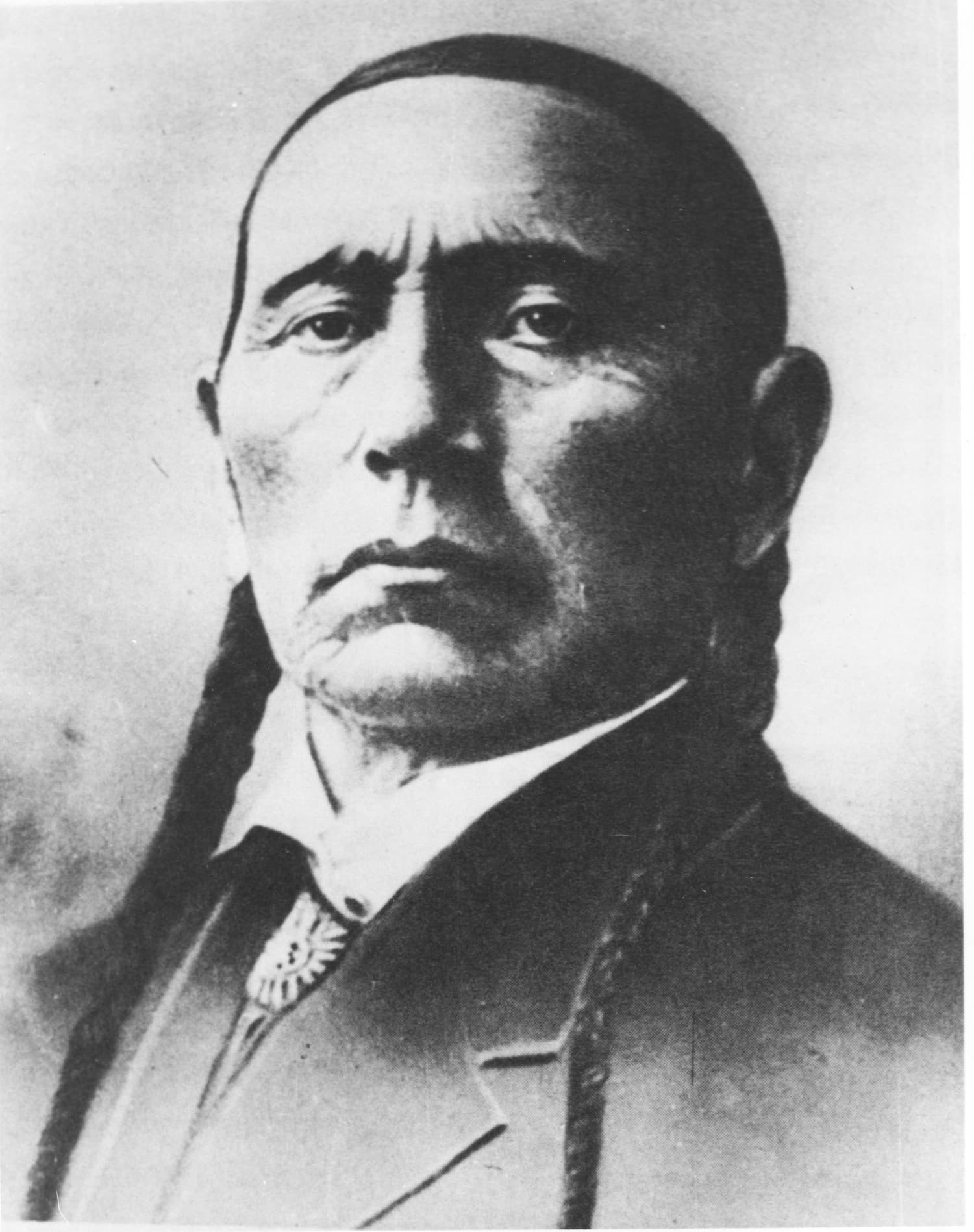
He was 24 and a Ranger scout when he found the trail that led Sul Ross to the Comanche camp on Mule Creek in December 1860, and he rode in with the rest of them. After the fight he cut the tracks of 2 horses leaving fast and followed them some 50 miles until he came in sight of a camp far too big to attack, and turned back. Quanah Parker said later that he had been one of the 2 riders. Goodnight, who lived to 93, told the story for the rest of his life, and in his last years was friends with Quanah's family.
Illinois to the Brazos
He was born in Macoupin County, Illinois, on March 5, 1836, the year of the Texas Republic, and rode into Texas bareback at 9 behind his mother's wagon in 1845, the year of annexation; he liked to point out both coincidences. By 20 he was running cattle on shares in the Keechi valley of Palo Pinto County, and by 1857 he was scouting for the Rangers against the Comanches. The Pease River fight made his name locally. Through the Civil War he rode with the Frontier Regiment, the state's own line against the raids, and came home in 1864 to a country where the cattle had run wild for 4 years and were worth nothing where they stood.
The trail
In 1866 he and Oliver Loving, 24 years older and a trail man already, drove about 2,000 head southwest from the Brazos, across the 80 dry miles to Horsehead Crossing on the Pecos, and up the river to Fort Sumner, New Mexico, where the Army was feeding 8,000 Navajos and paid 8 cents a pound. That was the Goodnight-Loving Trail. For the drive he had a surplus Army wagon rebuilt with a chuck box on the back; nobody had thought of it before. The next year Loving was hit by Comanches on the Pecos, got to Fort Sumner, and died of gangrene on September 25, 1867, after Goodnight promised to take him home. He did, the following winter, in a metal coffin, to Weatherford.
Goodnight ranched in Colorado for a few years, went broke in the panic of 1873, and in 1876 drove 1,600 head down into Palo Duro Canyon, where the Comanches had been run out only 2 years earlier. With the Irish financier John Adair's money he built the JA Ranch, the first in the Panhandle. By the time the partnership was divided in 1887 the JA covered about 1,325,000 acres and ran 100,000 head. He married Mary Ann Dyer, a schoolteacher, in 1870, and she was the only woman in the canyon for a long time.
After
He kept a few buffalo calves she asked him to save in 1878, and from them built one of the herds that kept the species alive. He crossed them with cattle and called the result cattalo. He founded Goodnight College in 1898 for ranch children, backed a silent film, and, at 91, on March 5, 1927, married Corinne Goodnight, a 26 year old nurse from Montana who shared his surname and had written to him about it. He died in Arizona on December 12, 1929; the Handbook of Texas says at his winter home in Phoenix, the Arizona record says Tucson. He is buried beside Mary Ann at Goodnight, in Armstrong County, the town the railroad named for him.
Larry McMurtry built "Lonesome Dove" on him and Loving. The Pease River country he scouted in 1860 is the country in Darden Canyon and the Matador.
Sources: Handbook of Texas, Charles Goodnight, Goodnight-Loving Trail, JA Ranch, Battle of Pease River; J. Evetts Haley, "Charles Goodnight: Cowman and Plainsman" (Houghton Mifflin, 1936; University of Oklahoma Press, 1949); Humanities Texas, Texas Originals, Charles Goodnight; Panhandle-Plains Historical Museum.