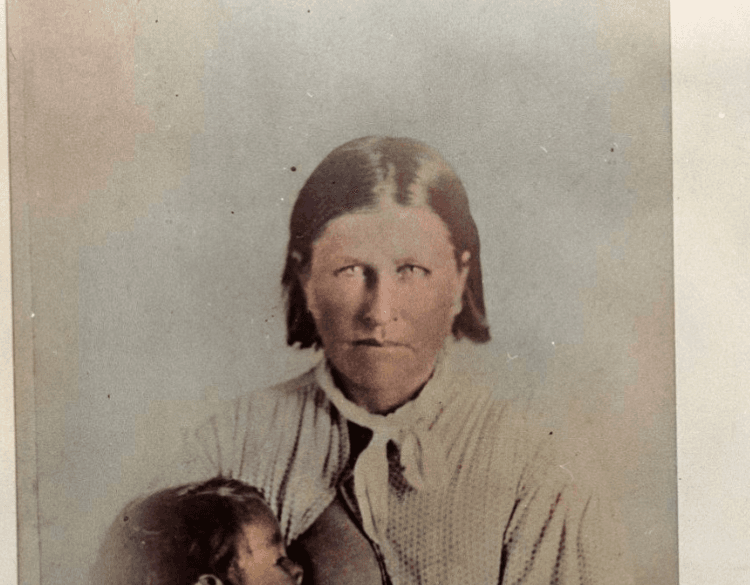
He was not at Mule Creek on December 18, 1860, when Sul Ross's Rangers rode into the camp on the Pease and took his mother away, or he said he was not. He was somewhere between 8 and 15 years old, depending on which birth year you believe, and he would spend the rest of his life insisting that the man Ross claimed to have killed that day was not his father. A historian finally agreed with him in 2012, a century after he died.
The Quahadi
Quanah was the son of Peta Nocona, a Nokoni war leader, and Cynthia Ann Parker, taken from Fort Parker in 1836 and made Comanche. His own best guess was that he was born about 1850 on Elk Creek below the Wichita Mountains; the Handbook of Texas says about 1845. After his mother was taken and his father died, of wounds from a fight with Apaches some years later by Quanah's account, he went to the Quahadi, the Antelope band, the most remote and least treaty minded of all the Comanches, who lived on the Llano Estacado and never signed anything. He rose there as a raider.
On June 27, 1874, he was one of the leaders of several hundred Comanche, Kiowa, Cheyenne and Arapaho who attacked the buffalo hunters' post at Adobe Walls in the Panhandle. The hunters had big rifles. Quanah's horse was shot from under him and he was hit by a ricochet. The attack failed, and the Red River War that followed broke the southern plains tribes in a year. In late May and the first days of June 1875 Quanah brought the Quahadi in to Fort Sill. He was the last.
Fort Sill
Then he did something harder than fighting. He learned the reservation. The agents, needing a Comanche they could deal with, made him principal chief, a position the Comanches had never had, and he used it. He leased reservation grass to Texas cattlemen, Burk Burnett and Dan Waggoner among them, and in 1884 the tribes got their first grass payments. He sat as a judge on the Court of Indian Offenses. He fought the government's allotment plan as long as he could, and when it came anyway he got the best terms he could. He took up the peyote religion after being gored by a bull in South Texas and defended it in front of legislatures; he is counted a founder of the Native American Church.
Burnett and other cattlemen put up money for his house near Cache, a 2 story frame house with white stars painted on the roof, 10 rooms by the Oklahoma Historical Society's count and 22 by the Handbook of Texas, with a room for each of his wives. He had 7 or 8 of them over his life and some 25 children, several adopted. He rode in Theodore Roosevelt's inaugural parade in March 1905, and in April the president came to Oklahoma to hunt wolves with him and Burnett. The town of Quanah, Texas, was named for him while he was still raiding, and he blessed it. He went looking for his mother's people in Texas, found his uncle, took the Parker name, and brought Cynthia Ann's body north to Post Oak Mission cemetery in 1910.
After
He died at Star House on February 23, 1911, of heart failure, and was buried beside her. In 1957 an Army expansion at Fort Sill moved the Post Oak cemetery, and on August 9 of that year he was reburied with full military honors on what is now called Chief's Knoll in the Fort Sill post cemetery, his mother next to him.
The water that runs off our Darden Canyon tracts reaches the Pease and passes Mule Creek; that connection is in Darden Canyon and the Matador. Roaring Springs, the Handbook says, was the Comanches' main camp in 1860.
Sources: Handbook of Texas, Quanah Parker, Cynthia Ann Parker, Battle of Pease River, Adobe Walls; Paul H. Carlson and Tom Crum, "Myth, Memory, and Massacre: The Pease River Capture of Cynthia Ann Parker" (Texas Tech University Press, 2010); William T. Hagan, "Quanah Parker, Comanche Chief" (University of Oklahoma Press, 1993); National Park Service, Quanah Parker; Oklahoma Historical Society, Quanah Parker Star House.