The Rangers who rode into the camp on Mule Creek on December 18, 1860, were killing the people who ran, most of them women, when one of them noticed that the woman he was about to shoot had blue eyes. She had a baby girl in her arms. She did not speak English. It took her uncle, brought up from Birdville, to put a name to her, and when he said "Cynthia Ann" she patted her chest and said it back. She had been Comanche for 24 years.
Fort Parker
She was born in Crawford County, Illinois, about 1825, to Silas and Lucy Parker, and came to Texas with the clan of Elder John Parker, who built a stockade on the Navasota headwaters in what is now Limestone County. On May 19, 1836, a large party of Comanches with Kiowa and Kichai allies hit the fort, killed 5 men including her father, and took 5 captives. The other 4 were ransomed or released over the next few years. Cynthia Ann was not. She was given a Comanche name, Naduah, grew up in the Nokoni band, and married Peta Nocona, a war leader. They had 3 children: Quanah, Pecos, and a daughter, Topsannah, called Prairie Flower. Traders who saw her in the 1840s and 1850s reported that she would not leave.
Mule Creek
Then Sul Ross came. The fight on the Pease, told from the Rangers' side in the Ross profile and from the land's side in Darden Canyon and the Matador, was over in minutes and killed roughly a dozen people, most of them women. She and Topsannah were taken to Camp Cooper and then to her uncle Isaac Parker's home at Birdville. In 1861 the Texas Legislature voted her a league of land and a pension of $100 a year for 5 years. It did not help. She tried more than once to get away and go back to the plains and her sons, and was brought back each time. She was passed from one relative to another, and ended at her sister's place near the Anderson and Henderson county line.
Topsannah caught influenza and died of pneumonia in 1864. Cynthia Ann, by the accounts of the people around her, stopped trying after that. The headstone at Fosterville, where she was first buried, says 1870; the one document from the period says March 1871. The Handbook of Texas notes only that the 1870 census still enrolled her, aged 45.
After
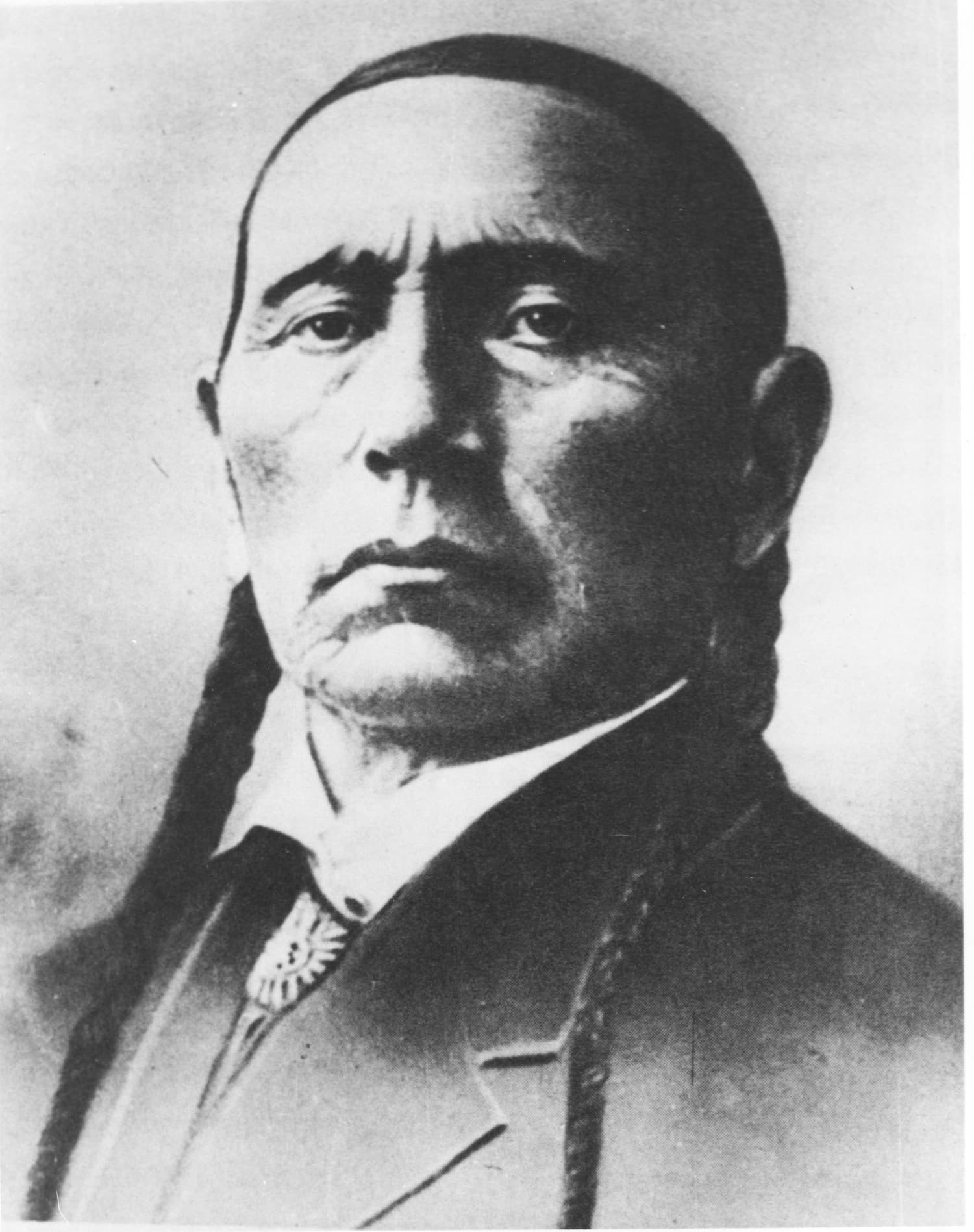
Pecos died young. Quanah lived, surrendered at Fort Sill in 1875, and spent the rest of his life finding out who she had been. He took her name. In 1910 he had her body moved from Anderson County to the Post Oak Mission cemetery near Cache, Oklahoma, and a year later was buried beside her. In 1957 the Army moved them both to the Fort Sill post cemetery, where they lie together with some 700 other Comanches.
She is the most famous captive in the American story and she left almost nothing in her own voice. The one photograph, taken at Fort Worth in 1861 with the baby at her breast and her hair cut short in Comanche mourning, is the whole record of what she thought about being rescued.
Sources: Handbook of Texas, Cynthia Ann Parker, Fort Parker, Battle of Pease River; Paul H. Carlson and Tom Crum, "Myth, Memory, and Massacre: The Pease River Capture of Cynthia Ann Parker" (Texas Tech University Press, 2010); Humanities Texas, Texas Originals, Cynthia Ann Parker; Jo Ella Powell Exley, "Frontier Blood: The Saga of the Parker Family" (Texas A&M University Press, 2001).