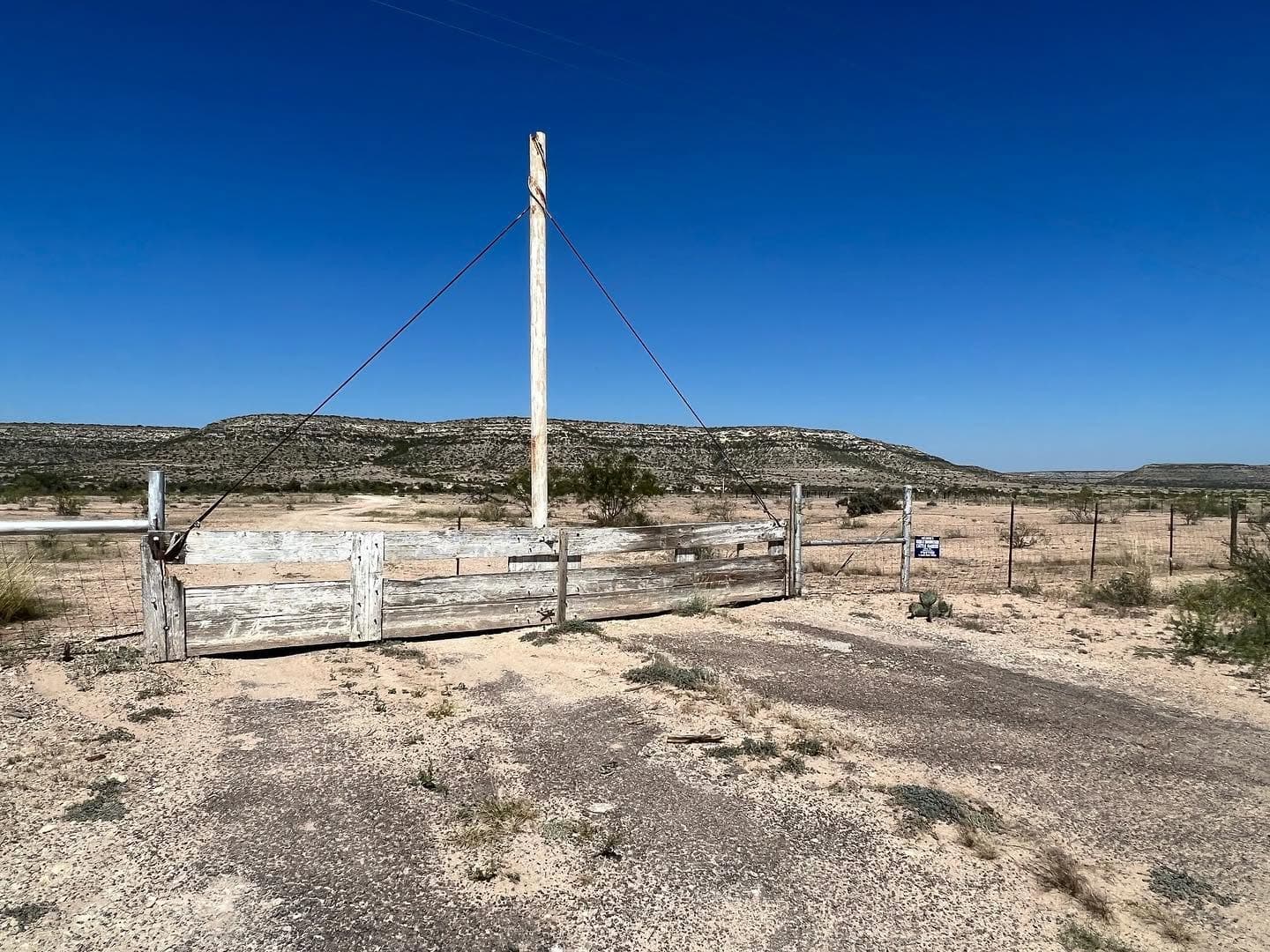
The first thing a newcomer learns on a ranch road in Edwards County is that the gate is not going to open for them. No keypad on a post, no remote clipped to the visor, no solar panel tilted at the sky. Just a long pipe gate hung on a tall post, closed across the road, with a sign on it and a lot of dents in it.
The second thing they learn, usually from whoever is riding with them, is to put the bumper against it and keep going.
That is a bump gate, and if you buy land around Rocksprings you are going to drive through a lot of them. Real estate listings in the county still give directions by them: 11 miles down County Road 650 to the bump gate with the ranch name on it. Meanwhile 100 miles east in Kerrville, and in most of the state, the electric opener has quietly taken over. This piece is about why the old gate held its ground out here, and about where it came from, because the history is better than you would expect from a piece of pipe.
How it works
A bump gate does not hang on hinges. The gate is fastened to loose collars that slip over a tall post set at one end of the opening. A heavy cable, sometimes two, runs from the top rail of the gate up to a point high on the post. When you push the gate open, the cable wraps around the post as the gate swings, and because the cable is anchored above the gate, wrapping it shortens the drop and lifts the whole gate an inch or two off its rest. Gravity does the rest. Once your truck is clear, the gate's own weight unwinds the cable and swings it back across the road, where it comes to rest against a stop.
That is the entire machine. No springs that rust, no motor, no battery, no board. The only maintenance is a post that stays plumb and a cable that is not frayed.
The skill is in the driving. You roll up slow, touch the gate with the center of the bumper, and accelerate through at a steady pace. Too slow and the gate swings back onto your rear quarter panel. Too fast and it goes the whole way around and comes back harder. Long trailers are the known weakness. Stock trailer drivers in this county learn to get out and prop the gate, which is a fair trade for the other 364 days of not getting out at all.
1875, Fort Worth
The self closing idea is older than the pickup truck. On June 15, 1875, the United States Patent Office issued patent number 164,605 to a Fort Worth man named Tunis Snider for an "improvement in farm gates." His gate hung from a chain on a separate post with no hinges at all. As the gate opened the chain wound around the post, and when you let go, the gate's weight unwound the chain and closed it. Snider's pitch in the patent was that the design would never sag, and that "a very small child" could work it.
It was meant to be pushed by a hand or a horse, not a Model T. But the geometry is the geometry. Every bump gate in Edwards County is running on Snider's 150 year old trick of letting the gate lift itself a little so it has somewhere to fall back to.
1925, the King Ranch
The version we drive through is usually credited to Robert J. "Bob" Kleberg Jr. of the King Ranch. The story, as Texas Monthly's Texanist tells it and as the King Ranch Visitor Center repeats it, is that in 1925 Kleberg was tired of stopping the truck at every cross fence and worked out the vehicle version with some engineers from the Humble Oil Company, who were on the ranch for the oil lease. The passenger no longer had to climb out, and since the passenger was usually Mrs. Kleberg, the ranch hands called them "ladies' gates." The King Ranch is said to still run around 150 of them.
The Texanist adds one honest footnote, and so will we: there are references to similar drive through gates in West Texas from before 1925. The King Ranch may have perfected it and certainly made it famous. Nobody can prove they thought of it first. If you have a photo or a family story of a pre 1925 bump gate anywhere west of the Pecos, we would genuinely like to see it.
The patent record backs up the idea that the gate was in the air in more than one place. Between 1949 and 1954 the Patent Office issued at least 3 bump gate patents: a gravity return gate to William H. Koch and Ernest Strom of Minnesota, an automatic bump gate and latch to Arthur G. Leake of Virginia, and, closest to home, a "vehicle operated bump gate" to Albert Dean Jr. of San Antonio, filed in March 1951. Dean's version had a spring loaded bumper and a hydraulic dashpot you could adjust to hold the gate open longer for a longer vehicle. It was a clever fix for the trailer problem. You will not find one on a county road today, which tells you something about what survives out here: the version with the fewest parts.
Why Rocksprings
Edwards County is 2,120 square miles with about 1,400 people in it. That is roughly 0.7 people per square mile, in a county that had 3,768 residents in 1910 and has been shrinking most of the time since. No railroad ever came. The Handbook of Texas puts the first reliable transportation at the state and federal highways of the 1930s. Off those two highways, nearly everything is county road and ranch road, graded caliche that runs for miles between gates.
Put a gate on a road like that and ask what it needs.
Power. A bump gate needs none. An electric opener needs a line run from the nearest pole, which on a 10 mile easement is not a line, it is a project, or it needs a solar panel and a battery. The solar kit works fine in June. It is the second week of overcast in January, with a 35 amp hour battery and a 16 foot gate cycling 30 times a day during deer season, that you find out whether it works in Edwards County. Everybody who has owned one has a story about the gate that would not open at 5 a.m. with 4 hunters in the truck.
Attention. Rio Grande Electric Cooperative, chartered in July 1945 out of Brackettville, carries the lines across most of this corner of the state, Edwards County included, over the largest and thinnest co op territory in the lower 48. But a gate opener is a machine with a circuit board on it, 40 miles from the nearest person who can fix a circuit board. A bump gate is a post and a cable. A rancher who can set a corner post can rebuild one in an afternoon with what is on the truck.
Livestock. This is the part people miss. The cheap alternative to any gate is a cattle guard, and cattle guards are everywhere in cow country. Edwards County was never cow country. At the 1940 peak the county ran 331,970 sheep and 376,322 Angora goats, and Rocksprings called itself the Angora goat capital of the world. A cattle guard does not stop a goat. Sheep and goats walk them. Farm Credit's own history of ranch gates calls the bumper gate the common alternative for sheep and goat raisers, and that is exactly who settled this plateau and strung its fences.
The goats are mostly gone, but their replacement makes the case even harder. Hunting is about 20 percent of the county's income by the Handbook's figure, and the brush is full of axis, aoudad, blackbuck, fallow and sika that were never native to it. A deer does not respect a cattle guard either. In a 2009 USDA Wildlife Services study, a bump gate kept white tailed deer out of every test enclosure, while the rolling deer guards they tested lost effectiveness as the deer learned to walk and jump them. The same study noted the bump gates had a real rate of mechanical failure, which anyone with a dented tailgate already knew. Still, on an exotic game ranch a full height swinging gate is the thing that actually holds a line, and if it closes itself, better.
Money. A fabricated pipe bump gate is a day of welding and a few hundred dollars of material. An opener on a 16 foot gate with solar and a keypad runs into the low thousands installed, and then you own a battery with a 3 to 5 year life and a control board that lightning likes. On a 60 acre tract that is a line item. On a 2,000 acre ranch with 6 cross fences, it is the reason nobody did it.
What the electric gate has over it
We are not going to pretend the bump gate is the better machine. It is the better machine for this road. The electric gate locks. It logs who came in. It does not swing into your horse trailer, and it does not require your mother in law to learn a new driving skill. Around Kerrville and Fredericksburg, where tracts are smaller, neighbors are closer and a gate is as much about privacy as livestock, the opener wins and should. Our High Ten tracts sit 20 minutes from Kerrville, and nobody out there is going to miss the bump gate.
Edwards County is different because the gate is doing a different job. It is holding goats, deer and a few cows on the right side of a fence at the far end of a road where nobody is going to steal anything but a feeder. For that job, an 1875 idea with a 1925 upgrade is still the cheapest thing that works, and out here cheapest thing that works has beaten newest thing that works for about a century.
If you are buying out here
Three practical notes from the land side, because we sell tracts behind these gates.
-
Know whether the gate is yours. Many Rocksprings tracts sit behind one or more bump gates on a shared easement. The gate belongs to whoever owns the land it sits on, and the easement agreement, if there is one, says who maintains it. Ask before you close. Our Edwards County tracts at Alamo Ranch, Republic Ranch and Lone Star Ranch come with deeded access and graded roads, and we will tell you exactly which gates you will drive through to get home.
-
Do not replace it until you have lived with it a season. New owners arrive with an opener in the truck bed. Most of them are still looking at the bump gate 2 years later and have made peace with it.
-
If you do go electric, go bigger than the kit says. Oversize the panel, oversize the battery, put the controller in a box, and keep the bump gate on the second fence line where the power is not.
Or do what the county has done since Bob Kleberg's day. Put your bumper on it, keep your foot steady, and do not stop.