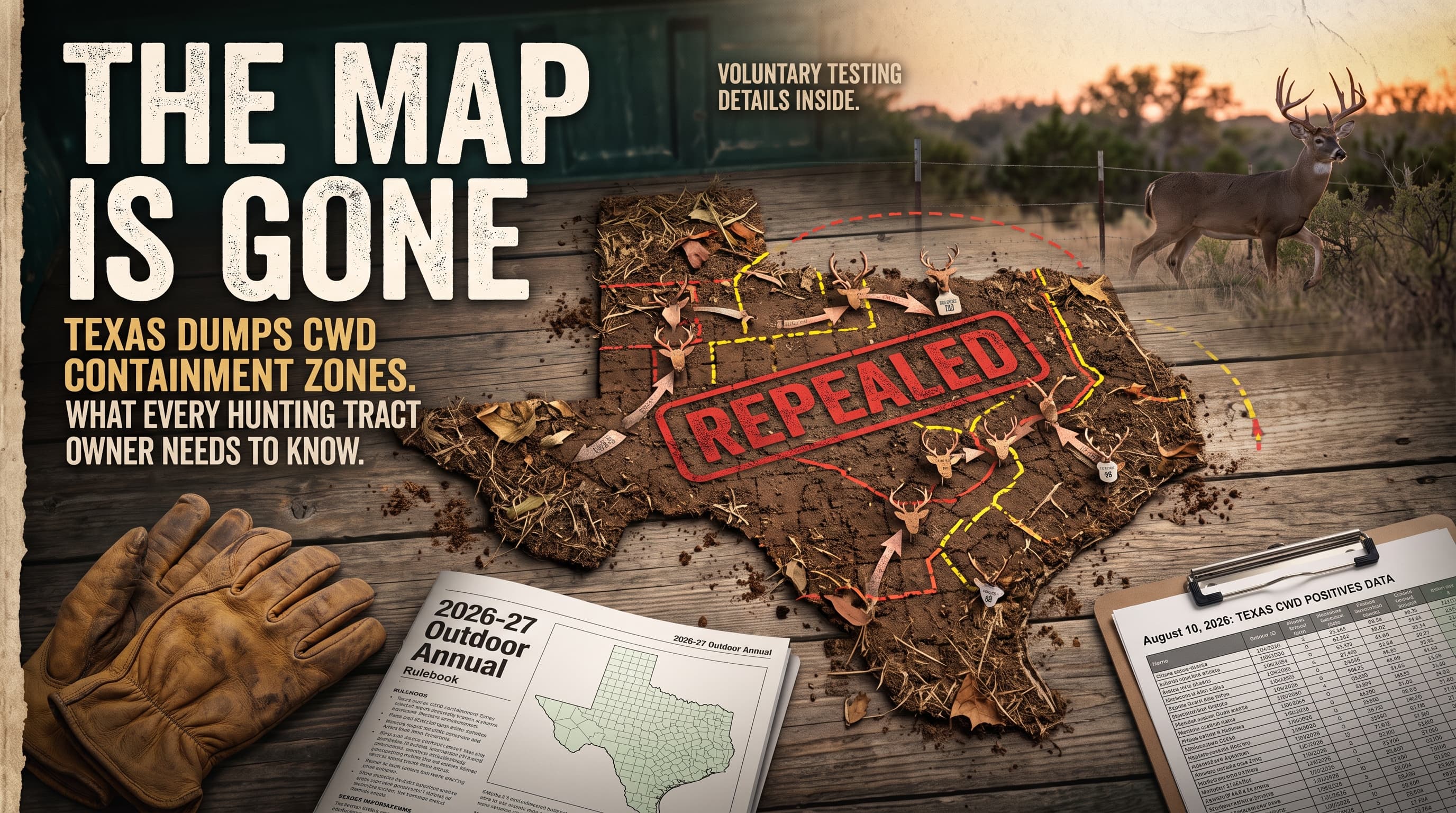
If you hunted Texas any time between 2012 and 2024, you learned to read a map with colored blotches on it: chronic wasting disease containment zones in one shade, surveillance zones in another, check stations marked with a pin. Shoot a deer inside a blotch and you had 48 hours to get its head to a state biologist, and you could not carry the carcass across the line.
Here is what almost nobody who bought a hunting tract this year knows. The map is gone.
On January 23, 2025, the Texas Parks and Wildlife Commission repealed the zone system and the mandatory check stations with it, unanimously, over public comment that ran heavily against it. The 2026-27 Outdoor Annual, the rulebook in your truck right now, lists no zones at all. What replaced them is a spreadsheet, and the spreadsheet has your county in it.
Some history first, because the disease has one.
Texas found its first chronic wasting disease on July 10, 2012: 2 mule deer in the Hueco Mountains east of El Paso, right after New Mexico found it across the line. The first captive whitetail turned up in a Medina County breeding pen on July 1, 2015. The first wild whitetail was a yearling buck on a low fenced place in Medina County on January 24, 2017.
Over the next 12 years the state drew 9 containment zones and 26 surveillance zones around every new find. By the 2024-25 season the list ran from Hudspeth to Lubbock to Kimble, with zones in Bandera, Medina, Uvalde and Val Verde. In June 2024 the commission made testing in all of them voluntary except 1 mule deer zone in the Panhandle. In January 2025 it threw out the zones entirely.
What it put in their place is a set of proximity rules that bind deer breeders, deer management permit holders and new facilities, not ordinary hunters: 5 miles around any free range whitetail positive, 25 miles around a free range mule deer positive. Inside those circles, pens test their deer and release sites keep harvest logs. Outside them, nothing changes. For a hunter on 50 acres, there is no zone, no mandatory check, no carcass movement line. There is a voluntary check station, if you want one, and there is 1 statewide rule about what you do with the parts you do not keep.
The disease did not go anywhere. The state decided the zone map was not stopping it, because the disease was not traveling on the hoof. It was traveling on the trailer.
The numbers are public, and they are not what the zone map implied.
Through August 10 of this year Texas has logged 1,398 positive deer since 2012. Of those, 159 were free range animals: 120 mule deer, 37 whitetail and 2 elk. The other 1,239 came with a facility identification number. 1,132 died in breeding pens; 106 were pen deer that had been released onto high fenced ranches; 1 was a state research pen. Of 1,398 Texas positives, 159 were wild deer. The rest had paperwork.
The pace changed in 2024. Texas found 163 positives in 2022 and 161 in 2023, then 434 in 2024, 193 in 2025 and 171 so far this year. More than half of every case the state has ever found was found in the last 3 seasons. And 441 of them, 31 percent of everything Texas has recorded, came from Hunt County, essentially from 1 operation, a breeding facility that fought the state to the Texas Supreme Court and lost on May 15, 2024. The state put down 249 deer there on May 28. Val Verde County has logged 4 wild positives in 7 years. One ranch in Hunt County has 441.
The state's own accounting of the trailers: in 5 years, 29 positive breeding facilities shipped 8,109 deer to 235 other facilities and 460 release sites across 139 counties. Against that, the state has tested more than 150,000 wild deer since 2002 and found 159.
So where do the counties we sell in stand? Here is the spreadsheet, as of August 10, 2026, in plain terms.
| County | Positives | Where they were |
|---|---|---|
| Kimble | 37 | 35 in 2 breeding pens, 2 on a release site in 2022 |
| Gillespie | 32 | 31 in 2 breeding pens, 1 release site deer in February 2026 |
| Duval | 21 | 20 in 3 breeding pens, 1 release site deer in February 2026 |
| Edwards | 9 | all in 1 breeding pen, April 2024 to September 2025 |
| Kerr | 7 | 6 in 1 breeding pen, plus the state's own research pen, later called negative |
| Val Verde | 4 | all free range, between Del Rio and Amistad |
| McCulloch, Menard, Schleicher, Motley | 0 |
Read the third column. In every county we sell in but 1, every positive deer died behind a breeder's fence or on a ranch that bought deer from one. The only wild positives in any county where we have a tract are the 4 in Val Verde: 3 found between December 2019 and September 2020, and an 8 and a half year old buck on April 21 of this year, the first new wild case there in 6 years. Under the 2025 rules that buck draws a 5 mile circle around itself near Del Rio that binds pens and permit holders inside it, and nothing else.
The neighbors are worth a glance too. Real County, east of Edwards, has 89 positives, 81 of them this year, in 1 facility. Medina County has 116, 18 of them wild, the most free range whitetail cases of any county in Texas. Uvalde has 189, 1 of them wild.
Nobody is going to put that table in a brochure. We are putting it here because you are going to find it anyway, and because the shape of it is the point: the disease in the Hill Country lives in pens, and the state has 10 years of data saying so.
What the rules actually require of you this season, on your own tract.
Carcass parts. Since the 2024-25 season there is 1 statewide rule. Whatever you do not keep for the kitchen or the taxidermist, if it leaves the property where the deer was killed, goes to a commercial trash service or a permitted landfill, or gets buried at least 3 feet deep under 3 feet of dirt, or goes back to the property it came from. You may debone anywhere. Meat travels no further processed than whole muscles, kept separate by deer, with the proof of sex and the tag riding along to the final destination. The easy version: quarter or bone it out at the gate, bury the rest on your own place, and you have complied without thinking about it.
Testing. Voluntary and free. There are 15 check stations statewide this season, open October 3 through February 28, with 24 hour drop boxes and appointments 9 to 4. The ones near our tracts: Kimble County at the old truck stop at Segovia, north of Interstate 10 at exit 465, and at South Llano River State Park; Val Verde at 4957 US 90 in Del Rio; Edwards County at the Rocksprings car wash on Highway 55; Gillespie at the Doss station on Ranch Road 783. Results come back in about 2 weeks with a 6 digit sample number. Sutton and the Panhandle are appointment only.
Feeding, baiting, protein, corn. No chronic wasting disease rule touches any of it in Texas.
Before you buy. The state publishes 2 things worth 10 minutes of your time: the case listing by county, and the trace out maps of properties that have received deer from positive pens since 2018. A tract that was once a release site for a positive facility carries harvest log duties and may be refused a managed lands permit. Ask, and we will check any tract of ours against those maps with you.
The breeders know the ground is shifting, and the 2025 Legislature was where they tried to shift it back.
There were 650 permitted deer breeders in Texas at the start of last year. A representative from Waco who is one of them filed a bill to abolish the Parks and Wildlife Department outright. Another bill would have stripped the department's authority over breeders and set fence heights by statute. A Senate bill would have declared breeder deer private property, which the Texas Supreme Court has said they are not. A fourth, from a senator in Brenham, would have required the high fence to come down 5 years after a release site stopped receiving deer; it passed the Senate 31 to 0 and died in the House. Every one of them was dead by the time the session ended on June 2, 2025.
Meanwhile the department's game wardens were working a case they called Ghost Deer: 24 suspects, about 1,400 charges across 11 counties, for smuggling wild deer into breeding pens and faking the disease tests on them. One February 2025 case involved deer headed for an illegal release in Duval County. The agency's director put the value of deer hunting to Texas at $9.6 billion a year when he announced the charges. That is the number everybody in the fight is actually arguing about.
Now the part of the state's October 1 announcement that made the headlines, and deserves them.
Texas has an estimated 5.64 million white tailed deer going into this season, after 3 straight years of above average fawn survival. The Edwards Plateau alone holds 1.973 million, up from 1.514 million in 2023 when the drought had thinned it. South Texas holds about 478,000, with mature bucks abundant and a 5 and a half year old averaging around 131 inches. The department's whitetail program leader said the obvious thing: Texas leads the country in hunters, in harvest and in deer.
Archery opened October 3 and runs through November 6. The general season opens Saturday, November 7, and runs to January 3 in the North Zone and January 17 in the South. Every county we sell in is North Zone except Duval and the sliver of Val Verde south of US 90. The bag in our Hill Country counties is 5 deer, 2 bucks; Duval, 5 and 3; Motley, 5 and 1, plus a mule deer season with a 20 inch spread rule. Not 1 of our 10 counties carries the 13 inch antler restriction.
Here is the practical case, then. The only chronic wasting disease rules that bind a person who owns 50 low fenced acres in Texas are the carcass rule and the voluntary test, and the only wild cases in any county we sell in are 4 deer in 7 years near Del Rio. The herd on the plateau is up 30 percent in 3 years. The counties with zero are McCulloch, where our Lohn Hollow tracts sit, Schleicher, where Brandon and Liberty are, Menard and Motley.
We have 308 surveyed tracts across 21 ranches, starting at $50,995, every one with a graded road to the gate and a survey on file, every one financed by us in house, with the monthly figure on the tract page. We will also point you to what the state's spreadsheet says about the county before you sign, which is more than most people selling hunting land in Texas will do. The zone map was retired in 2025. What survives is a spreadsheet, and it is worth 10 minutes of your time.
Read next: West Texas Is the Only Region Still Climbing · The Schleicher County Boom That Never Came
Sources: Texas Parks and Wildlife Department, listing of CWD positive cases in Texas and the underlying positives dataset, accessed October 5, 2026; TPWD Commission agenda items, January 23, 2025 (zone repeal and proximity standards), May 23, 2024 (statewide carcass disposal) and January 22, 2026 (disease management plan amendments); TPWD news releases of July 10, 2012, July 1, 2015, March 31, 2017, December 19, 2019, June 12, 2024, August 14, 2025, November 20, 2025 and October 1, 2026; the 2026-27 Outdoor Annual, county regulations, CWD check station pages and season dates; TPWD, Managed Lands Deer Program; Texas Animal Health Commission, elk and deer programs; Texas Legislature Online, 89th Regular Session, HB 4938, HB 3607, SB 2147, SB 2031, SB 2843, SB 2846 and HB 1379; Outdoor Life, May 2024, on the Hunt County depopulation; The Texan, 2025, on the commission's rulemaking; Texas Farm Bureau, June 2024, on the zone reductions.