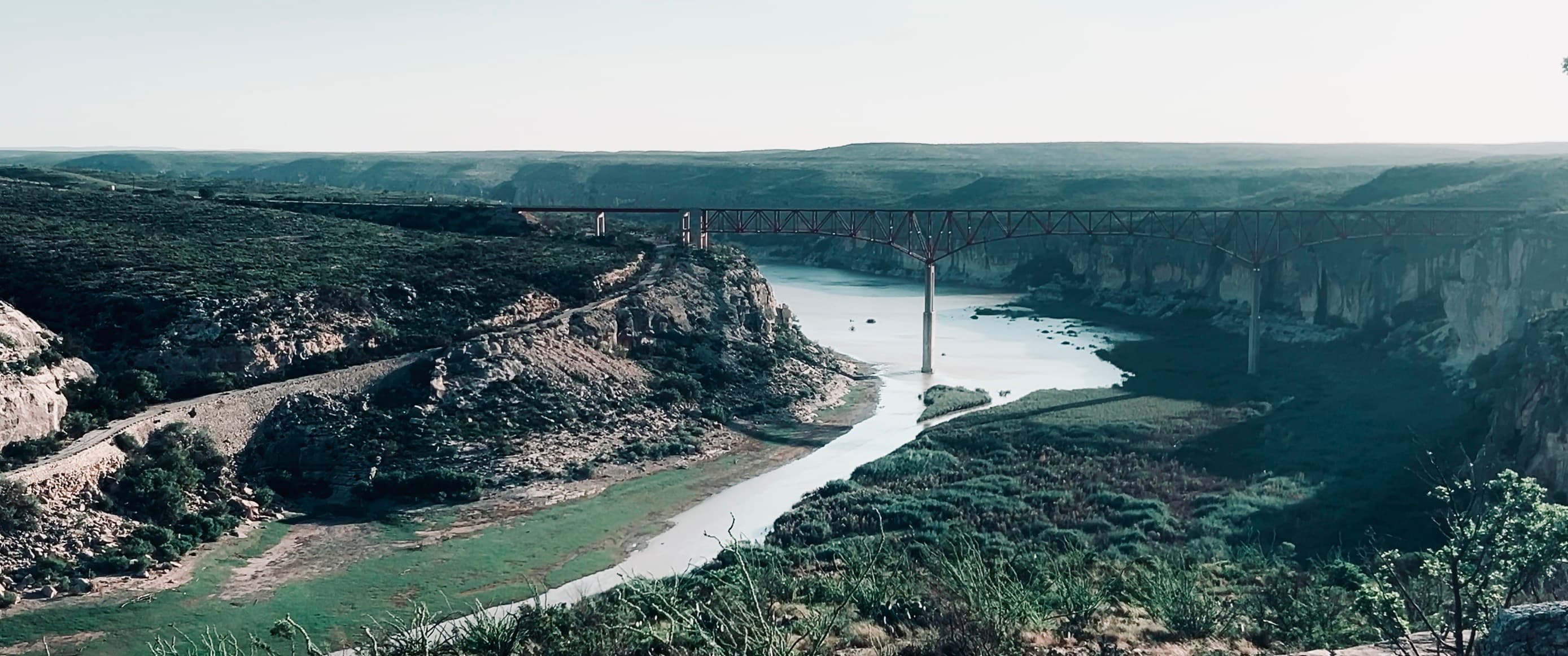
There is a spot on Highway 90 west of Comstock where the desert floor simply quits. The country runs along flat and certain, creosote and caliche and heat shimmer, and then the ground opens up and some 300 feet down, at the bottom of a limestone slot, sits the Pecos River, green and quiet, minding its own business on its last few miles before it gives itself to the Rio Grande.
Wait there long enough and a freight train will walk out into the open air.
It crosses the gorge on a steel bridge nearly a quarter mile long, its rails 322 feet above the riverbed, which makes it the tallest crossing in Texas. The state's highest highway bridge, a short drive down the same road you are standing on, was built 273 feet above the water. The trains beat it by about 50 feet, and they have held the title since 1892.
The bridge looks permanent. That is the first thing it is lying to you about. It is the second bridge to stand in that gorge, and the reason there is a second one is the Second World War.
Start in 1883. When the Southern Pacific closed the last gap in its Sunset Route between New Orleans and California, the Pecos was the meanest obstacle on the map, and the railroad crossed it the only way the engineering of the day allowed: at the bottom. A low iron truss sat near the river's mouth, the kind railroad men politely called a fair-weather bridge, and the track spent 5 or 6 miles on each side climbing down to reach it. Getting a train to the water and back out again meant two tunnels, each better than 1,500 feet long, plus 3,600 feet of wooden trestle and 2,730 feet of iron trestle hung along the canyon walls. Crews called the descent the Loop. It was slow, it was expensive to keep standing, and the rock above it had a habit of arriving on the track uninvited.
By 1891 the Southern Pacific had had enough of apologizing to the canyon, and decided to fly over it instead.
The plan was, by the standards of 1891, close to unreasonable. Beginning on November 3 of that year, the Phoenix Bridge Company of Phoenixville, Pennsylvania stood 24 iron towers in the gorge and laid 2,180 feet of track across their tops, 321 feet above the water. Crews finished on February 20, 1892. 87 working days, start to end.
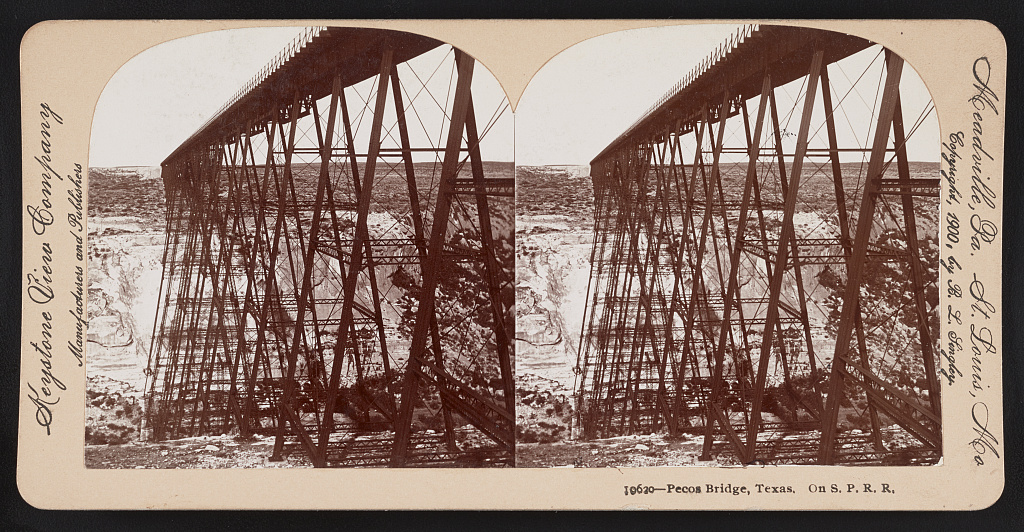 circa 1900
Understand what that bought. When it opened that March, the Pecos Viaduct was the highest railroad bridge in North America and the third highest bridge of any kind on Earth. Only the Garabit Viaduct in France, at 401 feet, and the Loa Viaduct in Bolivia, at 336, stood taller. Collis P. Huntington, the Southern Pacific's president, rode across on March 30, 1892, before the bridge had carried a single paying customer. The ledger recorded the cost at $250,108, which works out to a little over $100 a foot for a world-famous bridge.
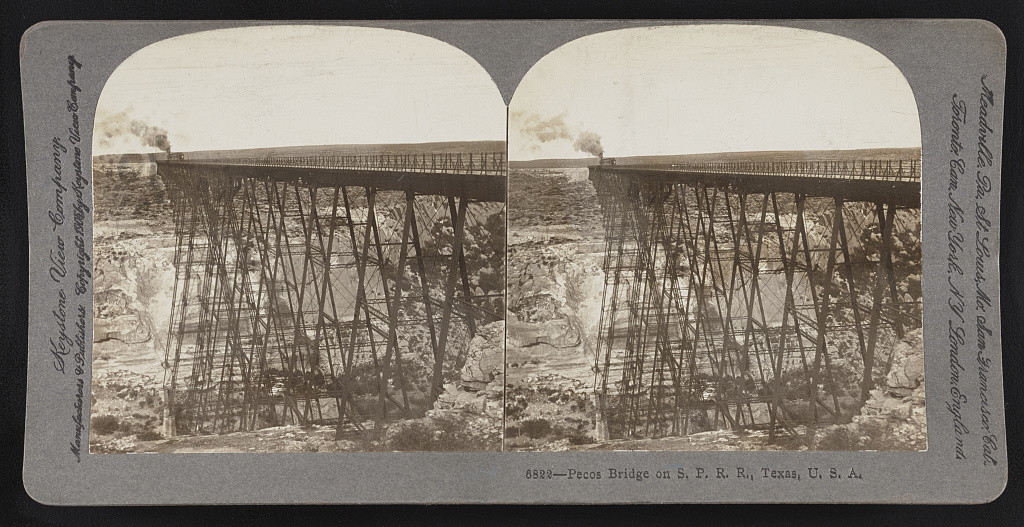 circa 1905
The viaduct did its job for half a century, but the job kept getting heavier. Locomotives grew, so the bridge had to grow underneath them. The railroad strengthened it in 1910, converting the central towers from 4 legs to 6 and shortening the crossing to 1,516 feet with an earthen embankment at the west end, then reinforced it again in 1929. The work nearly doubled the viaduct's weight. It was still, at heart, an iron bridge from the age of Benjamin Harrison, holding up a century that kept sending it more than the last one had.
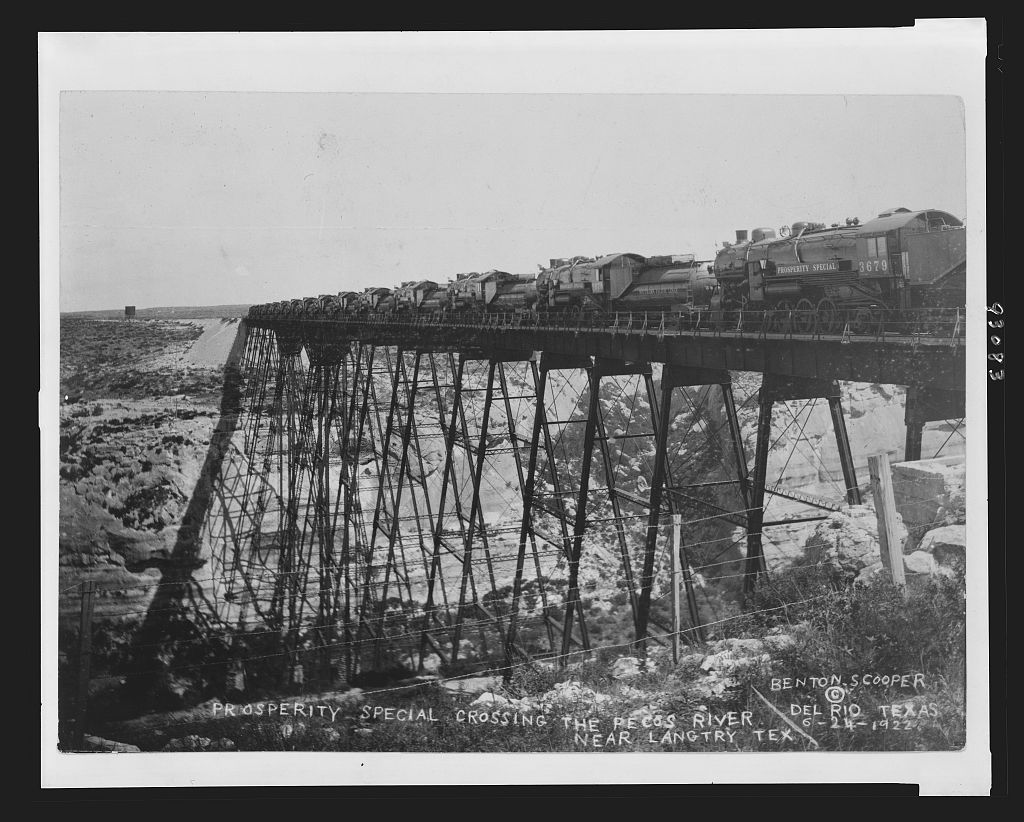 circa 1922
Then came December 1941, and the arithmetic changed overnight.
The Sunset Route was one of the country's main east and west arteries, and the war leaned on it with everything it had: troops, tanks, fuel, ammunition, all of it rolling toward the ports. Traffic climbed past anything the men of 1891 had planned for, and Southern Pacific's engineers arrived at an uncomfortable conclusion. Their 48-year-old viaduct might not carry all the weight it was about to be asked to bear.
Consider the problem from the War Department's chair. Here was a single bridge over a 300-foot gorge on a strategic railroad, with no practical detour worth the name. In peacetime that is a landmark. In wartime it is a bottleneck and a target wearing the same coat of paint.
So the government treated it like one. The Army posted guards at the crossing. And when the Southern Pacific began building a replacement, the War Department barred publication of anything describing the construction until the war was over.
The tallest bridge in Texas was rebuilt, in the open desert, as a secret.
Work started in August 1943, 440 feet downstream from the old viaduct. Steel was rationed so tightly that the project needed War Production Board approval before fabrication could begin, and the design shows it. Modjeski and Masters of Harrisburg drew a continuous cantilever truss with no ornament and nothing wasted, so austere that the engineers who later documented the bridge for the federal government noted, approvingly, how well it suits the desert. Brown and Root of Houston poured the substructure, slip-forming concrete piers up to 275 feet tall straight off the canyon floor, the height of a 25-story building. Bethlehem Steel hung 7 spans across them, the longest 374.5 feet, for a bridge 1,390 feet end to end with its rails 322 feet over the river.
They finished on December 8, 1944, 3 years and a day after the country entered the war. On December 21 the Sunset Limited, the railroad's flagship, became the first train across. The bill came to about $1.2 million.
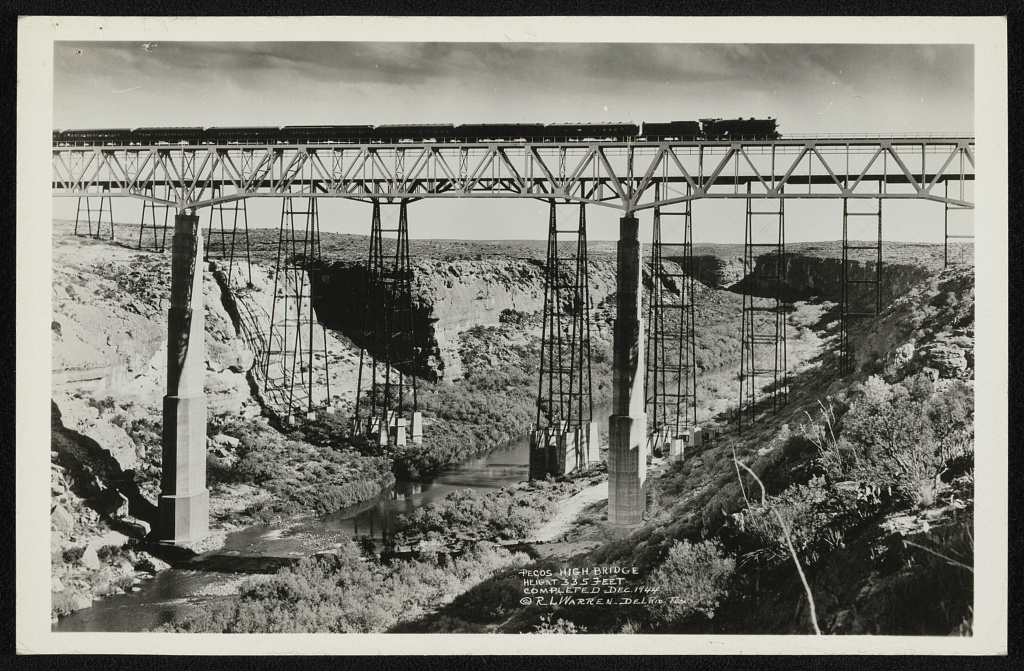
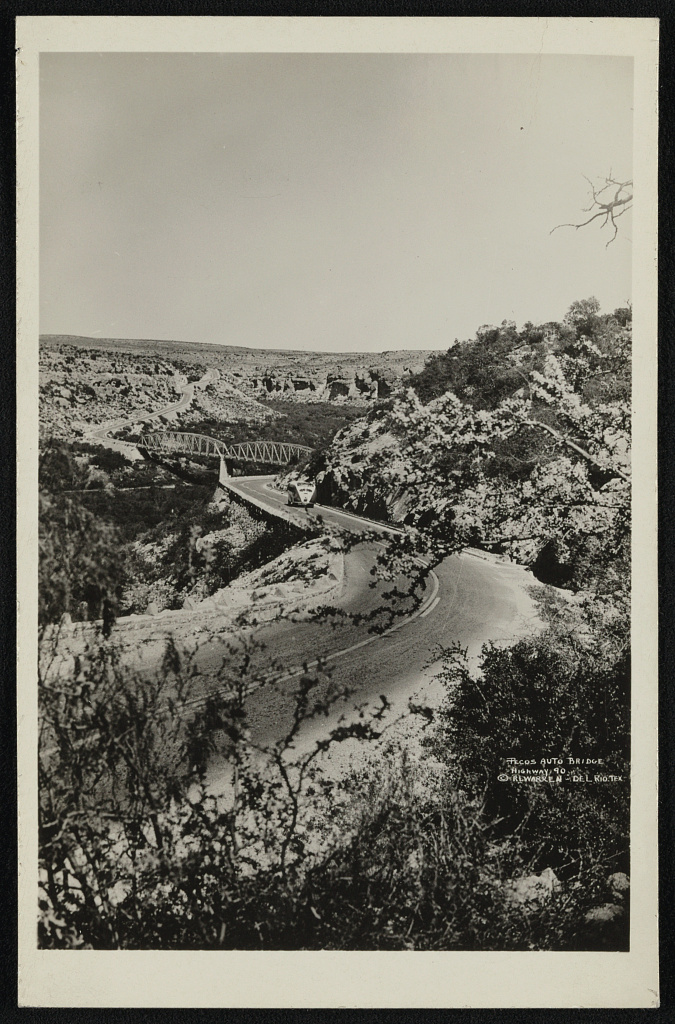
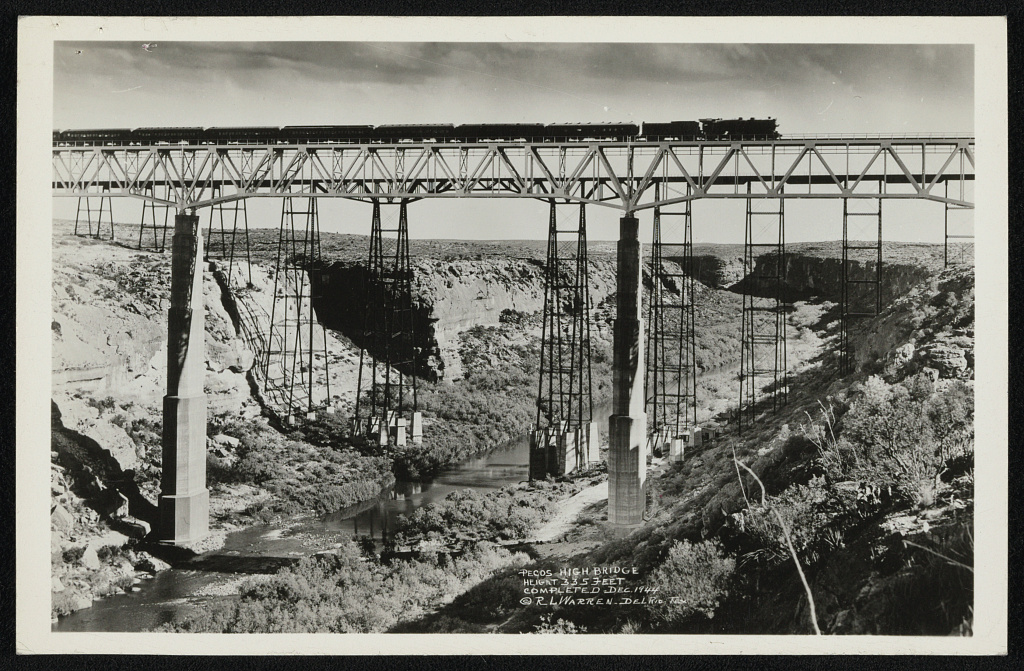 circa 1945
The old viaduct stood beside its replacement for another 5 years, out of work but not out of sight, until crews began taking it apart in 1949. Where it went is a genuine mystery, which is a strange thing to say about 1,516 feet of famous bridge. Depending on which account you read, sections were parceled out to highway departments in several states, or sold to Guatemala, or rebuilt over the Wabash River in Indiana, or simply cut up for scrap. A structure that was once the third highest bridge on Earth deserved a better-documented funeral. West Texas has never been sentimental that way.
Stand at the overlook now and you can read the whole story in one look, though the river has edited the numbers. When Amistad Reservoir backed water up the canyons, the Pecos rose to meet its bridge, and rails built 322 feet over the riverbed now ride about 265 feet over the pool. The 1944 spans still carry the main line, and the trains still walk out into the open air the way they have for 134 years.
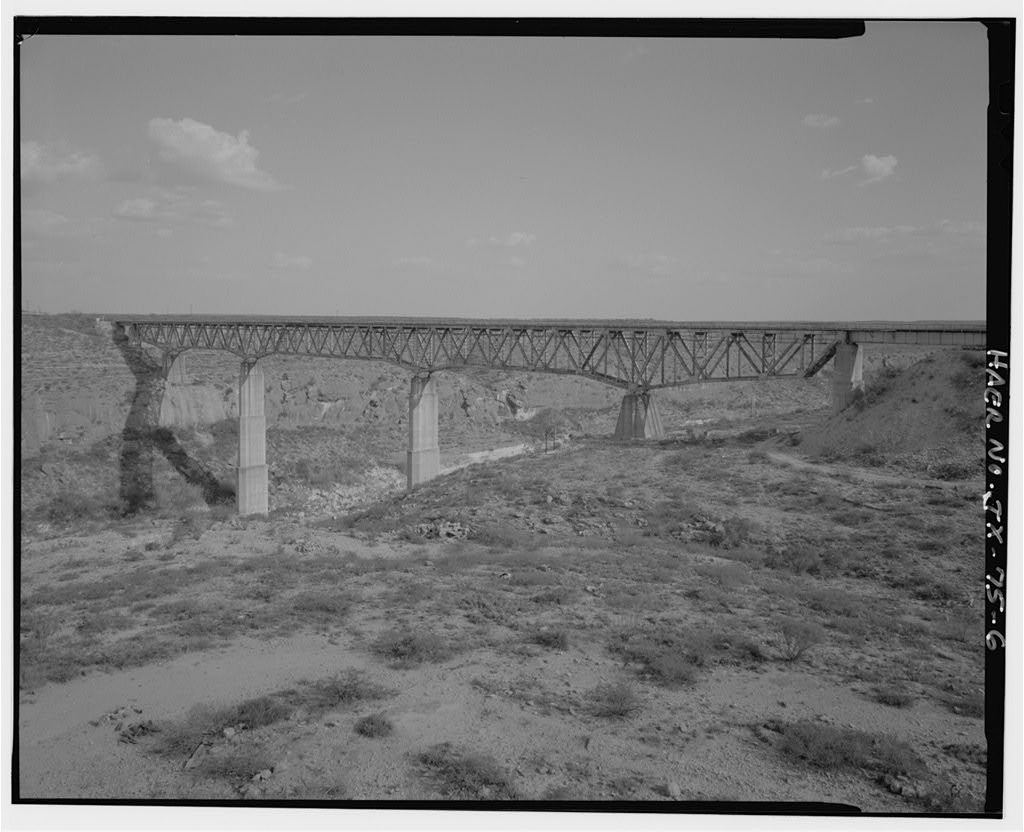
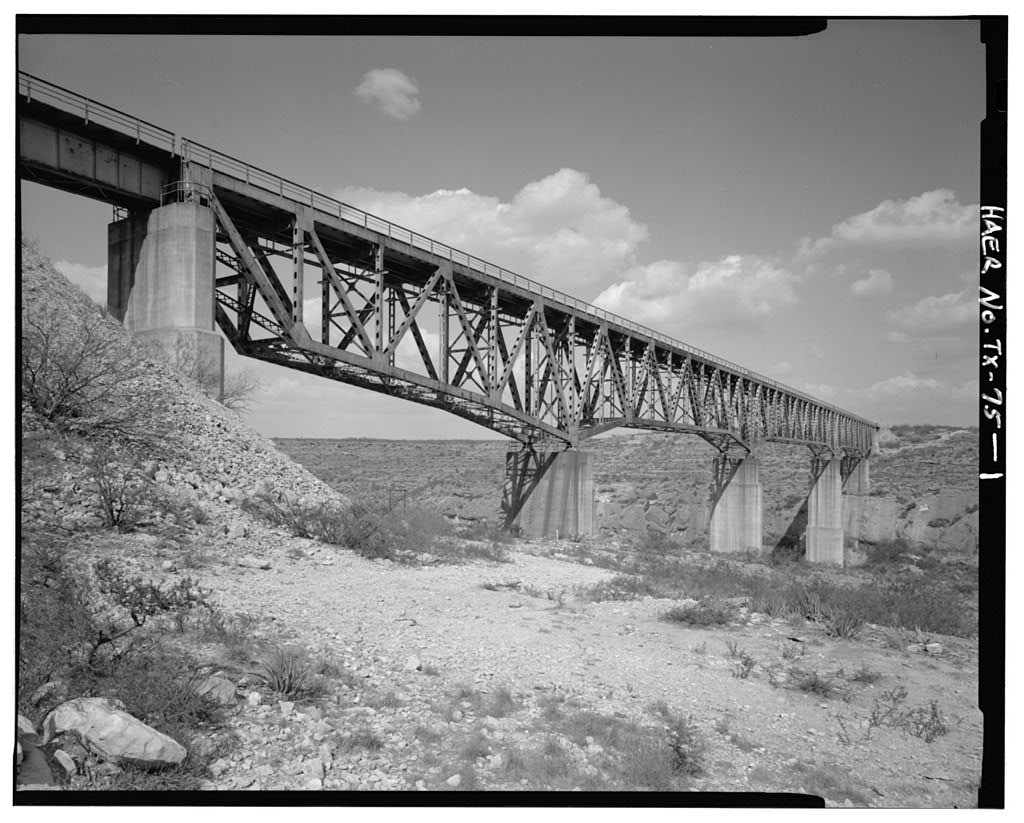
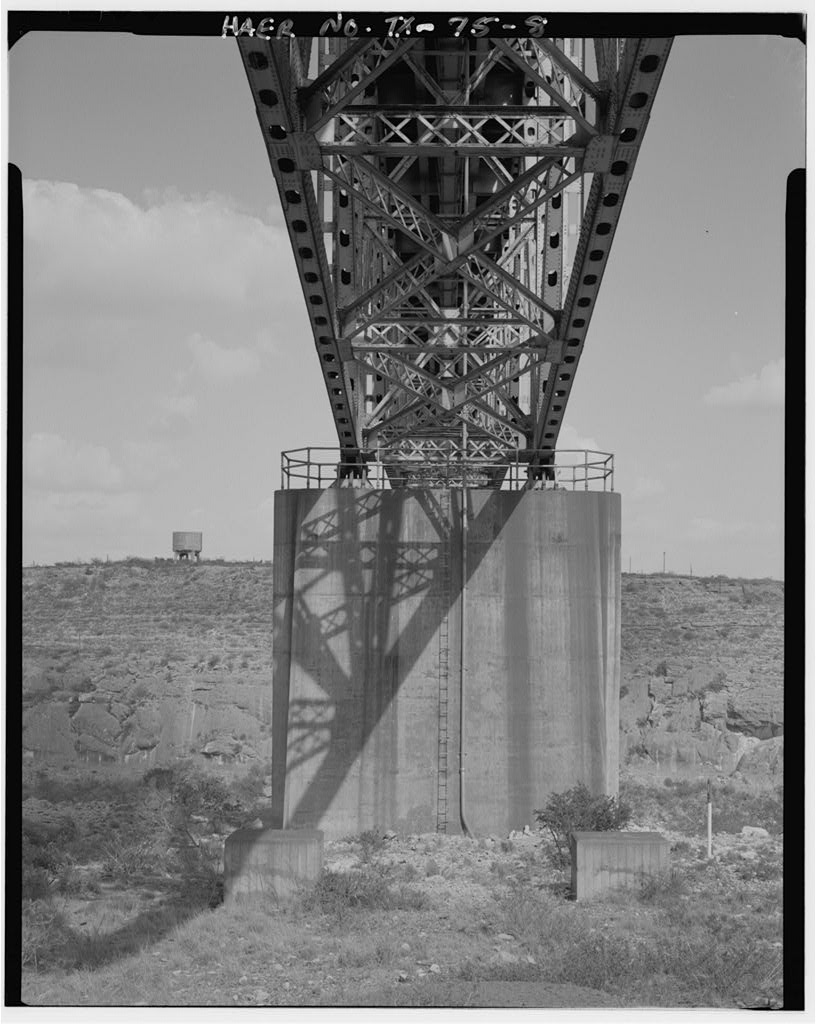 circa 1975
Permanence was never really the point. That is the quiet lesson of the gorge. The country needed a crossing, then a better one, then a stronger one, and each bridge got exactly as much permanence as the traffic could justify. The canyon is the only thing out there that never needed the upgrade. It was doing the hardest part, standing 300 feet deep in the middle of nowhere, long before anyone thought to bring a railroad, and it will be doing it long after the last train.
Bridge history from the Handbook of Texas of the Texas State Historical Association, the National Park Service, and the Historic American Engineering Record survey HAER TX-75 at the Library of Congress.