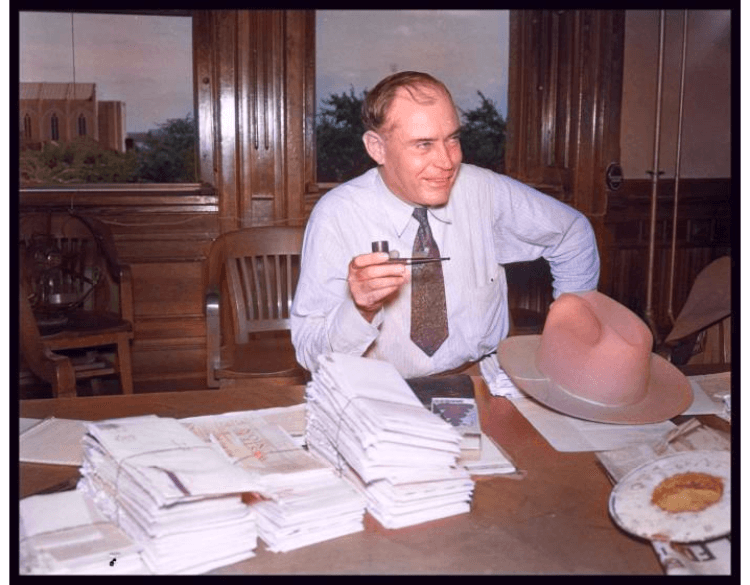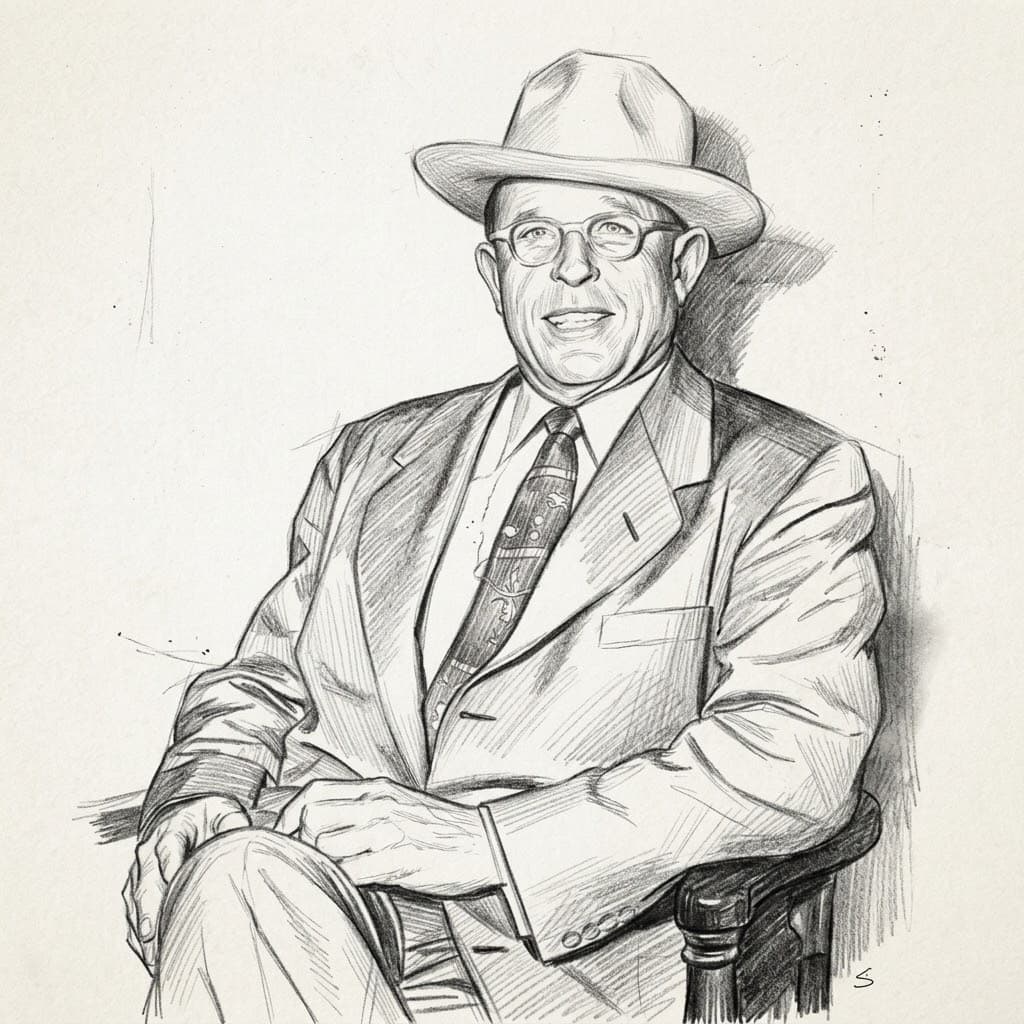
Most people meet Frank Hamer at the end of his career, on a parish road in Louisiana in May 1934, standing over the car that Bonnie Parker and Clyde Barrow died in. Kevin Costner played that man in "The Highwaymen" in 2019. He is in the Texas Ranger Hall of Fame. By most accounts he was the most capable lawman the state ever produced.
The Journal met him earlier than that, in a photograph taken at the Norias ranch house on the King Ranch in August 1915, holding a captured flag over 3 dead men he had not killed. Both men are real. This page is about how they fit together.
The Hill Country boy
Francis Augustus Hamer was born on March 17, 1884, at Fairview in Wilson County, the son of a blacksmith. The family moved west into the Hill Country while he was a child, to Llano County and then San Saba County, where he worked his father's forge and cowboyed for wages. At 16 he was shot and left for dead by a sharecropper who had tried to hire him for a killing. He recovered. That was the end of his boyhood.
By 1905 he was riding for the Carr ranch near Sheffield, on the Pecos. That fall he ran down a horse thief for the Pecos County sheriff, who wrote to the Rangers about him. He enlisted in Company C under Captain John H. Rogers on April 21, 1906, at 22, and was posted to the border.
Marshal, then back to the brush
He left in 1908 to be city marshal of Navasota, a railroad town in Grimes County with a reputation for shooting, and stayed about 3 years. The town got quieter. After a stretch as a special officer in Houston he went back to the Rangers in 1915, as a private in Company B, just as the border came apart.
That is the Hamer who appears in Hora de Sangre. He reached Norias after the fight of August 8, 1915, in time to pose for the postcard with the flag. From November 1915 to October 1918 he was off the regular roll, working as a brand inspector for the cattle raisers along the river, and came back a sergeant in October 1918. In between, on October 1, 1917, in Sweetwater, he and his brother Harrison were jumped on the street by 2 men with a grudge. Hamer was hit twice and killed one of them, Gee McMeans. His wife Gladys, married that year, was in the car.
On December 11, 1918, in Brownsville, Sergeant Hamer told State Representative José Tomás Canales, who was about to investigate the Rangers, that he was "going to get hurt," said it again in front of a witness, and then shadowed him around the Capitol while the hearings ran. The adjutant general made him apologize and had him serve Canales's subpoenas. He was never disciplined. Nothing in the record ties Hamer to the executions on the border, and his biographer argues he tried to stop some of them. Both things are in the file.
Captain
He made captain in 1921 and spent the 1920s in the oil towns. At Mexia in 1922 and Borger in 1927 he went in on the governor's orders and cleaned out the gambling halls and the bootleggers. He stood against the Klan when it was the most powerful organization in Texas politics, and more than once stood between a jail and a mob. At Sherman in May 1930 he and a handful of Rangers lost: the mob burned the courthouse with the prisoner inside it, and Hamer did not forget it.
His best piece of police work had no gunfire in it. In 1928 the Texas Bankers Association was paying $5,000 for any dead bank robber, no questions asked, and nothing for a live one. Hamer worked out that a ring of informers was recruiting drifters for robberies and tipping off the law so the drifters could be shot and the reward split. He could not get an indictment, so in March 1928 he took it to the newspapers. The bankers backed down.
He left the force after Miriam Ferguson won the governorship in November 1932. He had backed the other side, and the Fergusons cleaned out the Rangers when they came in.
102 days
On February 10, 1934, Lee Simmons, who ran the Texas prison system, hired Hamer as a special investigator with one assignment. Clyde Barrow had broken 5 men out of the Eastham prison farm in January and a guard was dead. Hamer studied the gang's circuit for weeks, decided they would come back to a family near Gibsland in Bienville Parish, Louisiana, and waited there. On the morning of May 23, 1934, he and 5 other officers, Maney Gault from Texas, Bob Alcorn and Ted Hinton from Dallas County, and Henderson Jordan and Prentiss Oakley from the parish, put well over 100 rounds into the Ford as it slowed. The hunt had taken 102 days.
He took no reward money and gave almost no interviews, which did more for the legend than any book could have. The guns from the car went home with the posse, which Texas still argues about.
After
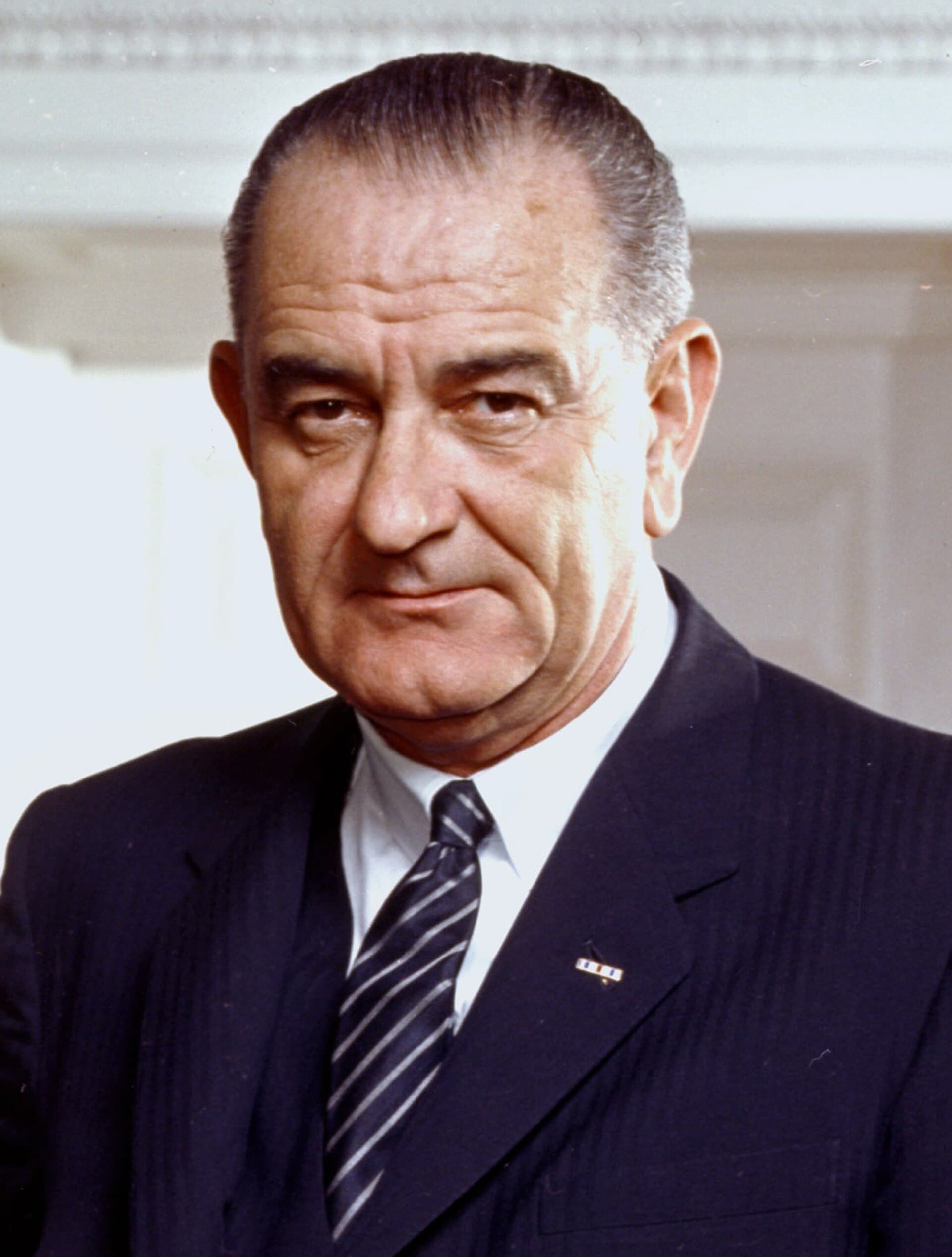
He spent the rest of the 1930s working for oil companies and shipping lines during the strikes, which his admirers leave out. In September 1948, at 64, he was back in South Texas for one more job: he walked Coke Stevenson into the bank at Alice, in Jim Wells County, past George Parr's armed men, to look at the tally from Box 13, the late votes that made Lyndon Johnson a United States senator. That story belongs to Duval County.
His son Billy, a Marine, was killed on Iwo Jima in 1945. Frank Hamer died in Austin on July 10, 1955, at 71, and is buried beside his son. The legend says he killed 53 men. His biographer, who counted, makes it about 21. In 1968 his widow and his surviving son sued Warner Bros. over "Bonnie and Clyde," which had played him as a fool, and settled.
Sources: Handbook of Texas, Frank Hamer; John Boessenecker, "Texas Ranger: The Epic Life of Frank Hamer, the Man Who Killed Bonnie and Clyde" (St. Martin's, 2016); Texas Ranger Hall of Fame and Museum; the Canales investigation transcript, 1919, Texas State Library and Archives; Robert Caro, "Means of Ascent" (Knopf, 1990); Refusing to Forget.